This article explains carbon steel flange material specifications. These specifications define the steel’s chemical makeup and physical properties. Using the correct specification ensures your flanges are strong, safe, and suitable for the job.
Common Carbon Steel Flange Material Grades
Carbon steel is not one single material. Different grades are designed for different conditions, like temperature and pressure. The most common specifications are set by ASTM International.
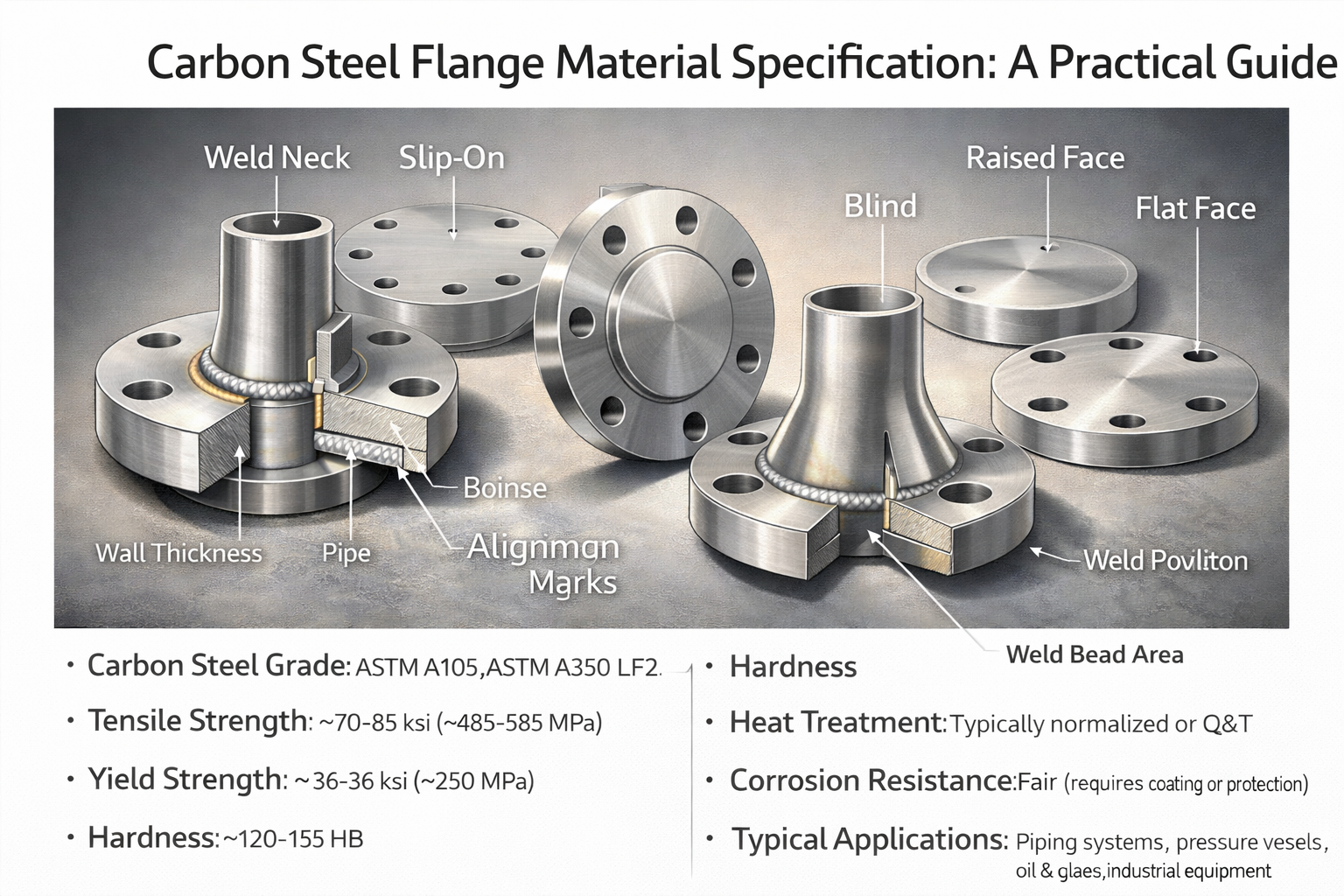
Here is a comparison of key carbon steel flange materials:
| ASTM Specification | Common Name | Key Characteristics & Typical Use |
| A105 | Forged Carbon Steel | The most common general-purpose material. Used for flanges in ambient to elevated temperature service. |
| A350 LF2 | Low-Temperature Carbon Steel | Designed for sub-zero environments. Has improved toughness to prevent cracking at low temperatures. |
| A694 F42/F52/etc. | High-Yield Strength Steel | Used for high-pressure piping systems, especially in oil and gas transmission. The “F” number indicates the minimum yield strength in ksi (e.g., F52 = 52,000 psi yield). |
| A516 Gr. 70 | Pressure Vessel Quality Plate | Commonly used for flanges cut from plate steel, especially for boiler and pressure vessel applications. |
Important Note: ASTM A105 is the standard for forged carbon steel flanges. Flanges made from plate material (like blind flanges or large custom flanges) often use different specifications, such as A516.
Understanding Key Specification Details
A material specification is more than just a name. Here’s what it covers:
1. Chemical Composition
The specification sets limits for elements like carbon, manganese, and silicon. For example, ASTM A105 has a maximum carbon content of 0.35%. More carbon increases strength but can reduce weldability.
2. Mechanical Properties
These are the “strength” requirements the material must meet, such as:
- Minimum Tensile Strength: The force required to pull the material apart (e.g., 70 ksi for A105).
- Minimum Yield Strength: The point where the material starts to deform permanently (e.g., 36 ksi for A105).
3. Heat Treatment
Some flanges require heat treatment (like normalizing) to achieve the right properties. For A105, this is mandatory for higher pressure classes (Class 400 and above) and special designs.
Pressure-Temperature Ratings: The Critical Link
A flange’s pressure capacity depends entirely on its material and temperature. A “Class 150” flange does not mean it can always hold 150 PSI.
A carbon steel flange’s maximum allowable working pressure decreases as the temperature increases. You must use a Pressure-Temperature (P-T) rating table to find the correct pressure class for your specific material and operating conditions.
Example: For ASTM A105 Carbon Steel (per ASME B16.5)
| Temperature (°F) | Max. Working Pressure for Class 150 (psi) | Max. Working Pressure for Class 300 (psi) |
| 100 | 285 | 741 |
| 400 | 94 | 503 |
| 600 | 31 | 200 |
Key Takeaway: At 600°F, a Class 150 A105 flange is only rated for about 31 psi, not 150 psi. Always consult the relevant P-T tables for your project.
Frequently Asked Questions
Q: Why choose forged carbon steel over cast iron?
A: Forged steel (like A105) has a uniform grain structure, higher strength, and better impact resistance. It is used for pressurized systems. Cast iron is more brittle and typically used for non-pressure applications.
Q: How do I match a flange material to my pipe?
A: Use compatible material grades. For an A105 flange, the typical matching pipe material is ASTM A106 Grade B, and the matching fitting is ASTM A234 WPB.
Q: Are carbon steel flanges corrosion-resistant?
A: Not inherently. Carbon steel is vulnerable to rust and corrosion. For corrosive environments, protective coatings (like galvanization) or different materials (like stainless steel) are needed.
Q: What does the “N” in A105N stand for?
A: The “N” stands for normalized, which is a type of heat treatment. A105N has been normalized to improve its grain structure and mechanical properties, often for better weldability.
Conclusion
Selecting the correct carbon steel flange material is a foundational engineering decision. It requires understanding the ASTM specification, the manufacturing process (forged vs. plate), and the crucial relationship between pressure, temperature, and material strength. Specifying the right material ensures system safety, reliability, and longevity.
Need help selecting the right carbon steel flange specification for your pressure, temperature, and application? Our technical team can guide you to the correct ASTM material and ensure it meets your project requirements.
Submit your specifications for a quote or technical support: http://texasflange.com/lp12/